

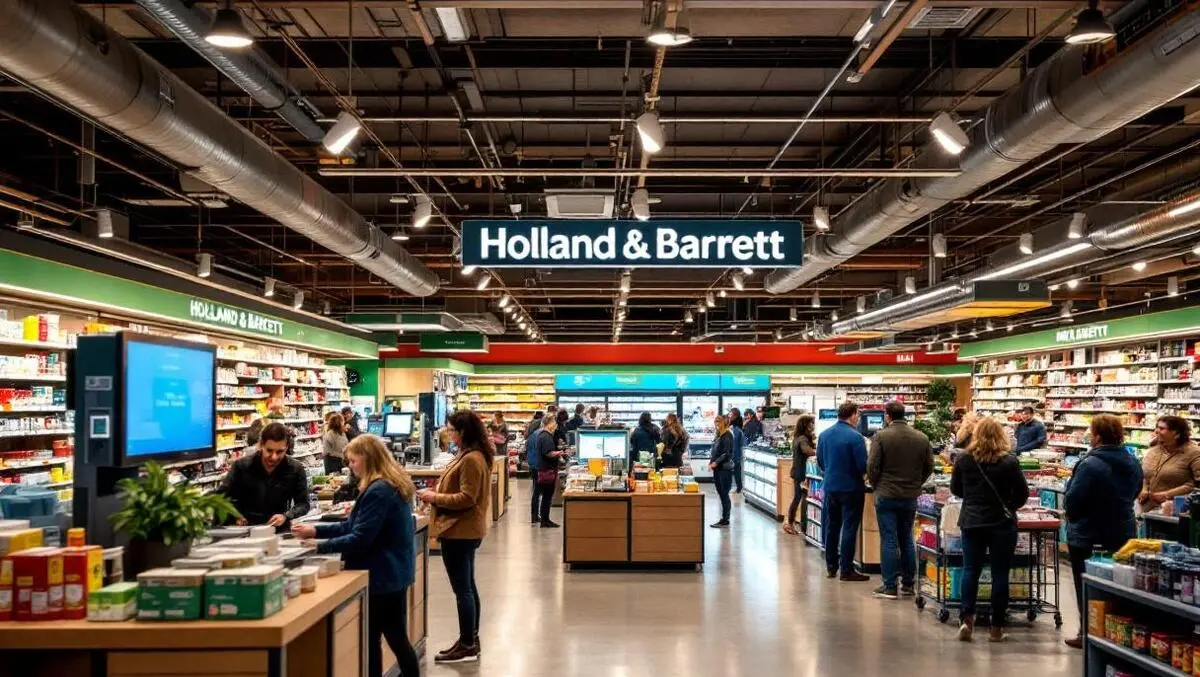
Holland & Barrett tech push lifts revenue towards GBP £1bn
Wed, 4th Mar 2026%201.webp)
Holland & Barrett reported 11% year-on-year revenue growth to £981 million for the year ended 30 September 2025, alongside a record £124 million capital spend, including £43.5 million on technology development.
The latest results mark its third consecutive year of double-digit revenue growth. The retailer said momentum should take annual revenue beyond £1 billion in the year ahead.
Technology development spend rose from £30.9 million in the prior year to £43.5 million in FY25. Total capital investment reached £124.0 million, covering store refits and refurbishments as well as technology.
Digital growth
Digital sales increased 20% year-on-year and accounted for more than 21% of total group revenue. The group added 1.3 million new digital customers across the UK and Benelux. Average order value rose 25% following updates to the app and website.
Holland & Barrett has taken ownership of its web, app and loyalty platforms. It described this as "full-stack ownership" and said it has enabled faster product changes and more personalised customer engagement.
The Group CEO positioned the technology programme as part of a wider shift in how the business competes.
"Our purpose is simple and powerful: to help people add quality years to life. With societal shifts towards prevention and self-care, there is an increasing global unmet need, which Holland & Barrett is well-positioned to serve. This year reflected the strength of our proposition, and we are energised by the momentum we've built as we continue to transition from a traditional retailer to a long-term health and wellness partner for our customers," said Anthony Houghton, Group CEO, Holland & Barrett.
Supply chain systems
A central element of the programme is an in-house demand and fulfilment platform. Holland & Barrett said it provides a real-time view of stock at unit and batch level across distribution centres, third-party logistics partners and stores, and includes production and in-transit inventory in its data model.
The retailer has retired its legacy AS400 system, which previously supported finance, stock and supply chain operations, and rolled out more than 30 new in-house retail and supply chain systems. It described the result as a unified digital backbone for operations and customer engagement.
Holland & Barrett said the changes support AI-driven forecasting, replenishment, pricing and personalised engagement. It added that the updated architecture produces structured data at scale, used across pricing, replenishment and customer activity.
Automation investment
Holland & Barrett has opened an AutoStore robotic fulfilment centre in Burton-on-Trent. The site uses 94 robots operating across 76,000 bins, and includes 19 ports and an eight-lane sortation loop, according to the company.
The retailer said the facility is designed to double units-per-hour output compared with manual picking and to support smaller, more frequent deliveries to stores. It linked that approach to lower back-of-house stock holding and improved working capital efficiency.
Holland & Barrett said it has more than 500 colleagues in its Technology & Automation division and continues to invest in operational infrastructure and customer-facing technology.
Store technology
In stores, the group has deployed proprietary stock management and point-of-sale systems, including self-checkout and mobile payment. Holland & Barrett said the tools improve shelf availability, reduce out-of-stock risk and support management of short-date inventory.
The retailer has also linked loyalty data with colleague interactions. It described this as a "loyalty and clienteling engine" that connects purchase behaviour with personalised advice delivered by trained colleagues in store and through digital interfaces.
Financial picture
Gross profit increased to £579.9 million from £524.2 million in FY24. Operating costs were 54.3% of sales, compared with 55.1% a year earlier.
EBITDA was £81.6 million, broadly in line with FY24 (£86.2 million). The group ended the year with £43.1 million in cash and net assets of £560.4 million, down from £71.7 million in cash and net assets of £644.4 million a year earlier.
Vineta Bajaj, Group CFO, said the group is entering a new phase after building out its infrastructure.
"FY25 represents a significant milestone in our multi-year transformation programme. With the foundations now in place across our supply chain, technology and estate, we are moving at pace through the first stage of this journey and shifting our focus decisively towards margin progression, simplification and returns. We are now well-positioned to deliver stronger, more sustainable returns from that investment," said Bajaj.