

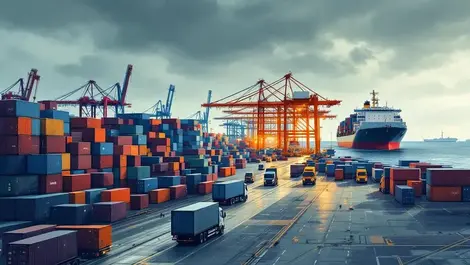
Transport firms warn of conflict-hit supply chains

Transport and storage businesses have reported a sharp rise in concern about the effect of international conflict on their operations, according to the latest Office for National Statistics business survey.
The survey found that 29.4% of firms in the transport and storage sector were concerned about the impact of international conflict on their supply chains over the next 12 months, while 15.2% were worried about shipping disruption.
That marks a steep increase from December, when 6.5% of businesses in the sector were worried about the impact of international conflict and 5.4% cited shipping disruption. The change amounts to a rise of 22.9 percentage points in conflict-related concern and 9.8 percentage points in concern about shipping and supply chain disruption.
The transport and storage category includes logistics, parcels, haulage and warehousing employers, making it a useful indicator of strain across goods movement networks. The rise in concern comes as companies continue to monitor shipping lanes and regional instability in the Middle East.
David Jinks, head of consumer research at Parcelhero, linked the increase to the recent conflict involving Iran and its effect on trade routes.
He said: "The latest Business Insights survey, held between 16-29 March, found that 29.4% of transport & storage sector businesses are concerned about the impact of international conflict on their supply chains over the next 12 months. A further 15.2% are concerned about shipping disruption.
"These results follow the USA and Israel's surprise attack on Iran at the end of February and the resulting conflict across the Middle East. The repercussions included the effective closure of the Straits of Hormuz, a vital shipping lane.
"This represents a huge escalation in the number of businesses expressing worry over these issues. In December 2025, only 6.5% of transport & storage companies expressed anxiety about the impact of international conflict on their business and 5.4% about potential shipping disruption.
"That is an unprecedented jump of 22.9 percentage points in just four months. Similarly, the 9.8 percentage point increase in concern about supply chain disruption is a sharp rise.
"However, even more manufacturers and retailers are concerned. Among manufacturers, 42.3% are worried about the impact of international conflict on their business and 28.7% about supply chain disruption. Among retailers, 39.4% are concerned about the impact of conflict on their business and 31.8% about resulting supply chain disruption.
"To put those responses into perspective, last December only 13.8% of manufacturers and 15.6% of retailers were concerned about international conflict, while 6.1% of manufacturers and 14.8% of retailers were worried about supply chain disruption. That 28.5 percentage point increase among manufacturers highlights how quickly concern has risen over global uncertainty.
"The fragile ceasefire between the US and Iran will have come as a welcome respite for many UK businesses affected by the conflict. However, international supply chains face higher costs and disruption for months, even if the truce holds."
Wider impact
The figures suggest concern is not limited to logistics operators. Manufacturers recorded the highest level of anxiety, with 42.3% saying they were concerned about the impact of international conflict on their business, while 28.7% pointed to supply chain disruption.
Retailers also showed elevated concern, with 39.4% worried about the impact of conflict on their business and 31.8% concerned about disruption to supply chains.
Compared with December, both sectors also recorded substantial increases. At that time, 13.8% of manufacturers and 15.6% of retailers were concerned about international conflict, while 6.1% of manufacturers and 14.8% of retailers were worried about supply chain disruption.
That means manufacturers saw a 28.5 percentage point increase in concern over international conflict in a matter of months. The retail and transport figures point in the same direction, with businesses that depend on predictable shipping schedules and stable sourcing facing a more uncertain outlook.
The pattern matters for the wider UK economy because transport and storage companies sit at the centre of many supply chains, linking importers, exporters, shops and factories. When concern rises in that sector, it can signal pressure on delivery times, freight costs and inventory planning across multiple industries.
Recent events in the Middle East have added to existing strains in global trade networks already tested by geopolitical tension and volatile shipping conditions. Any disruption around major maritime routes can have knock-on effects for cargo movements into and out of the UK.
For businesses, the figures show how quickly sentiment can shift when conflict threatens a key trade route. As Jinks noted, even with a ceasefire in place, supply chains may face higher costs and disruption for months.