


AI investment could help construction firms retain staff
Mon, 27th Apr 2026
More than half of construction professionals would be more likely to stay with their employer if it increased investment in AI tools, according to a PlanRadar survey of 1,728 professionals across 14 countries, including Singapore.
The findings suggest AI is seen less as a threat to jobs and more as a way to ease pressure in a sector facing staffing strains and rising competition for skilled project management workers.
Overall, 58% of respondents said AI could reduce major day-to-day challenges such as keeping projects on schedule and managing changes during delivery. Nearly half said they spend more than 11 hours a week on tasks they believe AI could streamline.
Among those already using AI-integrated tools, two-thirds said they save at least two hours per project each week. Even so, nearly half said they have no current plans to invest in AI-enabled tools.
The gap between interest and adoption may be especially relevant in Singapore, where the construction and built environment sector is under pressure to lift productivity while attracting and retaining experienced staff.
Retention effect
More than half of respondents said greater investment in AI and technology tools would make them more likely to stay with their current organisation. That challenges the common concern that construction workers see AI mainly as a source of job displacement.
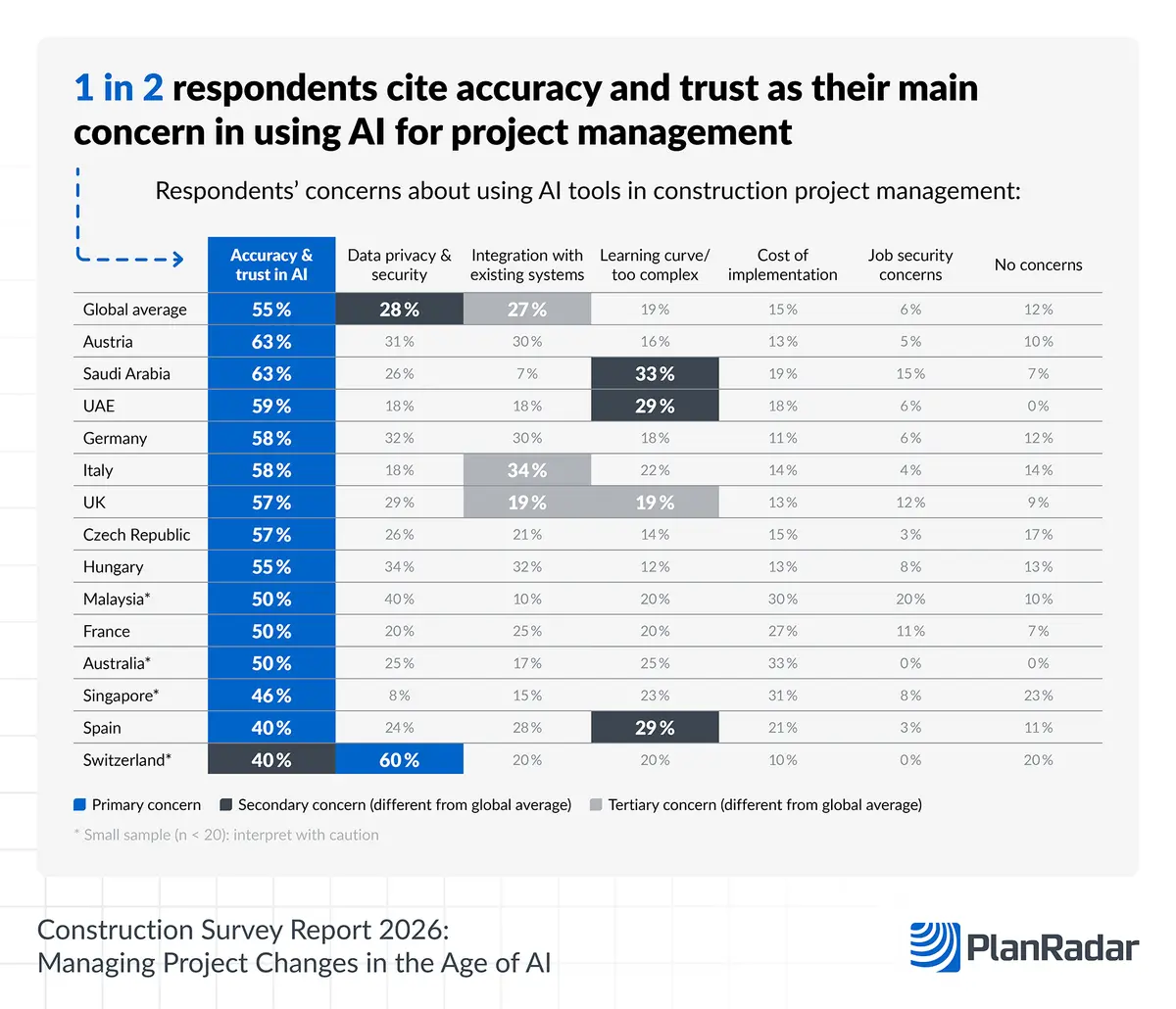
Globally, fear of job loss ranked as the lowest barrier to adoption. Respondents were more focused on whether the tools were reliable, useful and worth the cost.
"Construction professionals are spending more than a full working day every week on tasks that AI can reduce," said Ibrahim Imam, co-founder and CEO of PlanRadar. "In a market where talent is increasingly hard to attract and retain, failing to invest in the right tools is a risk organisations may not fully appreciate."
The wider labour picture adds to that concern. The Project Management Institute estimates the construction sector will need nearly 2.5 million additional project professionals by 2035, a 60% increase from current levels.
Deloitte has also reported that construction wages have risen 4.2% year on year as companies compete for a smaller pool of workers. Against that backdrop, the survey indicates digital tools may support not only productivity, but also staff retention.
Singapore barriers
In Singapore, trust was the main barrier to AI adoption, mirroring the global pattern. Respondents cited accuracy and confidence in AI recommendations as their leading concern.
Cost was the second-biggest barrier in Singapore and carried more weight than in the global findings. This suggests firms are closely assessing whether the gains from AI justify the investment.
The pattern points to caution rather than outright resistance. Businesses appear to be weighing the case for AI against concerns about reliability and data handling.
"Construction professionals are not resistant to AI. They are asking for tools they can trust," said Sander van de Rijdt, co-founder and CEO of PlanRadar. "AI must deliver reliable outputs while ensuring sensitive project data remains protected. Trust cannot be an afterthought."
Industry context
All survey respondents were directly responsible for delivering projects on time and on budget. They worked in project management and consultancy, general contracting, specialist contracting, architecture and development.
That lends weight to the findings in a sector where delays, design changes and communication gaps can quickly affect costs and delivery schedules. Many professionals appear to see AI as most useful in handling these routine but time-consuming pressures.
The report was based on a 37-question online survey conducted in January among respondents in Europe, the Middle East and Asia-Pacific. PlanRadar, which sells digital documentation, communication and reporting software for construction, facility management and real estate projects, has more than 170,000 users in over 75 countries.
For Singapore, the results highlight a familiar trade-off. Employers may see AI investment as an added cost at a time of margin pressure, while workers appear to view it as a practical tool that can reduce repetitive tasks and make demanding project roles more sustainable.
Nearly half of respondents said they still spend more than 11 hours each week on work they believe AI could streamline.