


Will adopting an AI system gain you a competitive edge? It might. However, as AI becomes deeply embedded in business decision-making across the globe, organisations must reconsider what they count as knowledge.
Already, we see AI tools actively shaping what organisations consider to be intelligence, influencing how decisions are made, who is heard, and what kinds of insight are recognised.
The question is no longer whether AI supports decision-making, but rather what forms of knowledge it promotes or excludes, as what we build into AI systems today will determine how organisations think, learn, hire and lead tomorrow.
Machine-Compatible Intelligence Becomes the Default
In most AI-enabled workflows, intelligence is defined as something quantifiable, predictable, and standardisable. The models are optimised for what can be tracked, measured, and reproduced, treating all else as noise. This results in a preference for machine-compatible insights and intelligence and thus, tends to overlook nuances of what is uncertain, felt, or embedded in context, the very qualities that often shape learning and judgement.
Across sectors, this pattern is already visible:
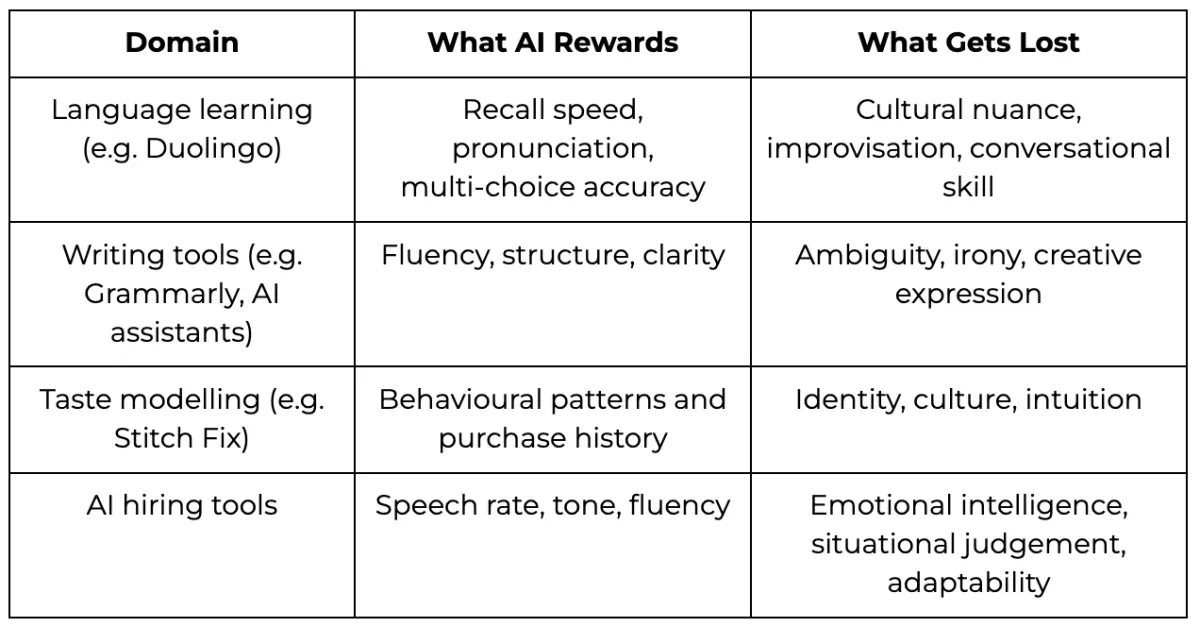
It becomes clear that AI systems actively shape how users understand what intelligence is, and as learners, writers, or candidates adapt to AI's expectations, they will inevitably try to match behaviours with what can be scored, losing important context that often makes all the difference.
The Real Risk: Epistemic Narrowing
AI systems are built on digitised, standardised data that is mostly drawn from English-speaking, Western contexts. This means they routinely exclude many other forms of knowledge, such as ecological, spiritual, communal, and embodied forms of knowledge.
Even large language models reproduce these limitations, with responses often employing translation-like shortcuts that bypass cultural nuance, thereby simplifying linguistic richness and reducing the different ways people can understand and interpret the world.
As a result, machine-learning-driven dashboards, hiring platforms, automated evaluations, and digital workflows gradually standardise organisational thinking and, consequently, narrow the company's critical thinking over time.
Why This Matters for Strategy and Leadership
To avoid problems in the future, managers must make conscious efforts now to complement AI output with human insight, ensuring the balance between data and judgment remains. The key issue becomes not whether AI systems are ethical by design, but whether organisations are deliberate about what forms of intelligence they validate.
As your organisation adopts AI, consider how it has already affected your collective knowledge, and ask yourself these four questions:
- What forms of intelligence is the system designed to recognise?
Review the behaviours that are measured, scored, and optimised by your system. And more importantly, ask what is missing and whether that matters in your domain.
- What forms of insight are hard to formalise but still relevant?
Frontline experience, intuition, cultural context and lived experience rarely appear in dashboards but often drive meaningful outcomes. You could integrate them by including story-based evaluation, feedback interviews with frontline staff, and collaborative review workshops to combine community insight with data modelling.
- How does this system shape learning inside the organisation?
Consider how the system influences your team's thinking over time and what is being prioritised versus what is slowly losing value.
- Who decides what gets selected as valid data?
Open the loop of who defines the categories, selects the training inputs, and sets your company's success metrics, to ensure nothing gets left out.
Reclaim Intelligence as a Design Choice
As AI becomes increasingly central to business operations across all sectors, it reshapes how insight is defined and whose knowledge is trusted; however, our AI systems reflect our choices. The difference between succeeding and existing in the market lies in your organisation's deliberation surrounding these choices.
Remember that your competitive edge when using AI will come not from the system itself, but from knowing what forms of intelligence to preserve, recognise, and reward within the organisation.