

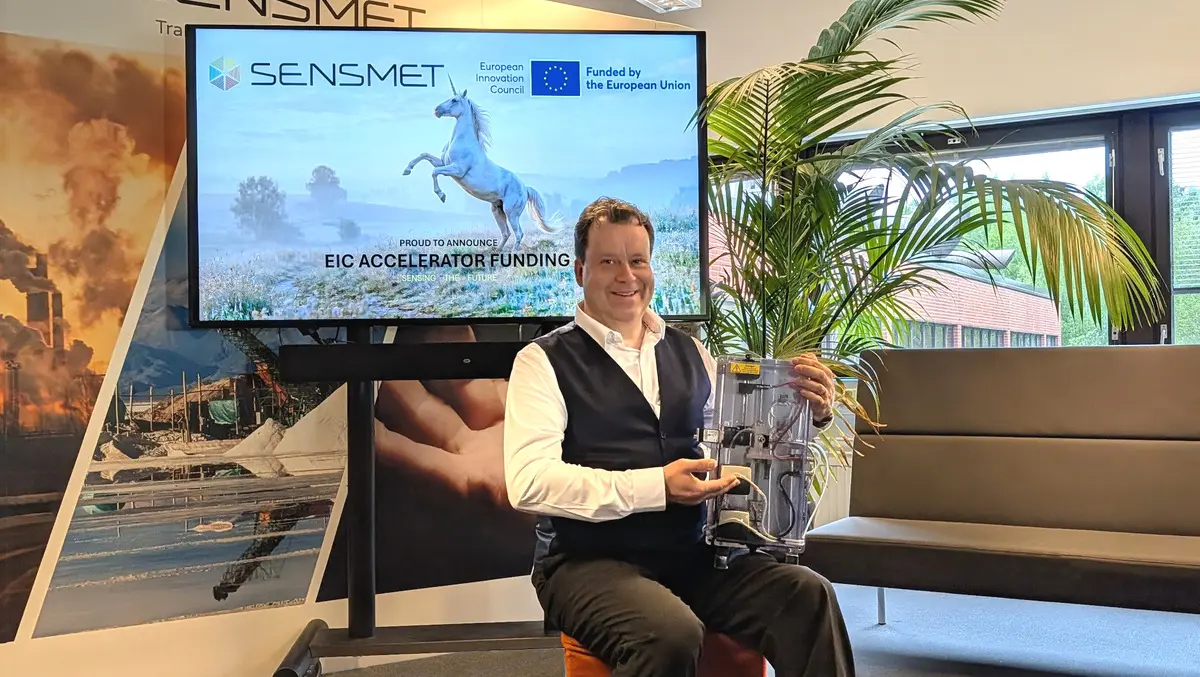
Sensmet wins EUR 2.5 million grant for water monitoring
Mon, 15th Jun 2026
Sensmet has received a €2.5 million grant from the European Innovation Council Accelerator, adding to a separate €1.5 million investment from EIT RawMaterials.
The Finnish company develops instruments for continuous water quality and metals monitoring. It will use the new funding to improve the versatility of its Micro-Discharge Optical Emission Spectroscopy, or μDOES, technology.
Founded in 2017, Sensmet has focused on real-time multi-metal analysis of aqueous samples. Its systems are used in areas including strategic materials production and recycling, particularly battery metals and rare earth elements, as well as applications such as monitoring residual palladium after catalytic processes.
The EIC Accelerator is part of the European Union's innovation funding framework for companies developing new technologies. The backing supports work aligned with the bloc's efforts to strengthen supplies of critical raw materials.
Process monitoring
Sensmet's μDOES system is designed to analyse several metals continuously in liquid samples. The technology can monitor elements including lithium, nickel, sodium, cobalt, manganese and copper in real time, with data displayed locally and transferred into a customer's process management systems.
The underlying method is based on atomic emission spectroscopy. A micro-discharge is created inside the sample, heating a microscopic volume of fluid and generating light emissions from excited atoms, which are then measured to quantify the metals present.
Sensmet is positioning the system as an alternative to conventional sampling and laboratory analysis in industrial processes. That is particularly relevant in sectors where delays in measurement can affect output, recovery rates and process control.
Battery materials production and recycling are among the markets identified by the company. It also points to mining, wastewater and other industrial settings where operators need continuous measurement of dissolved metals.
Dr Toni Laurila, Chief Executive Officer at Sensmet, linked the grant to both technology development and commercial plans. "The EIC Accelerator is one of the most competitive deep-tech SME funding instruments in Europe, so this award represents powerful third-party validation of both our technology and our commercial roadmap. More specifically, this award will primarily be used to advance μDOES, further improving its capability to enable customers to perform high-precision measurements directly at the point of value creation, where real-time chemical intelligence has the highest impact," Laurila said.
Broader markets
Sensmet's management argues that demand for trace metals analysis extends beyond raw materials processing. The company sees opportunities in environmental, pharmaceutical and energy-related applications where faster analysis in the field or at the process line could replace slower lab-based workflows.
Duane Sword, Board Member at Sensmet, set out that view more broadly. "The need for precise trace metals analysis in solutions spans many markets and applications from environmental to pharmaceutical and energy. Over recent years we have seen an evolution of chemical measurement technologies, such as Raman, FTIR, NIR, and Mass Spectrometry, that started in the laboratory, and have been adapted for process analysis. Many of these have been miniaturised towards field-deployable, portable solutions to perform analysis at the point of need, for fast decision making. Sensmet is leading the effort to bring optical emission spectrometry out of the lab and into the process, and beyond," Sword said.
Continuous multi-metal analysis could be significant in the production and recycling of lithium, cobalt and nickel, which are widely used in batteries, renewable energy systems and manufacturing. In such operations, operators often rely on periodic sampling and external laboratory testing, which can introduce delays between a process change and a measurement result.
Laurila said that gap is one of the main issues the company is trying to address. "There are two clear factors underpinning the enormous potential that this represents. First, continuous multi-metal analysis offers substantial process, financial and environmental benefits in critical processes. Metals such as lithium, cobalt and nickel, for example, are essential for batteries, renewable energy systems, and advanced manufacturing.
"Second, the traditional approach to metal measurements in liquid processes has involved sampling for laboratory analysis, which incurs delays and causes inefficiency. Continuous measurements with μDOES completely resolves these issues," Laurila said.
Commercial push
The latest funding comes as Sensmet expands its commercial footprint. It is building out its sales and service network as it seeks longer-term industrial relationships around its measurement systems.
Aappo Roos, Chief Sales Officer at Sensmet, said: "This funding marks our transition from a technology innovator to a long-term industrial partner. For us, it's no longer just about selling a sophisticated analyzer; it's about solving our customers' daily operational headaches. To support this goal, we are building our global sales and service network to provide world-leading industries with reliable, real-time elemental data every single day."